Let’s talk about what it means to have a HEART for teaching. Culturally relevant teachers are critically conscious, culturally competent, and know how to advance student learning.
I also added a fourth component, volition.
Dr. Gloria Ladson Billings, the author of culturally relevant pedagogy, does not explicitly name volition as a component; however, the idea of volition is woven throughout the framework, so I include it in my analysis to support and enhance my understanding.
By definition, volition means the power of choosing or determining. It is associated with willpower. So, what does it mean to have volition as it relates to culturally relevant pedagogy?
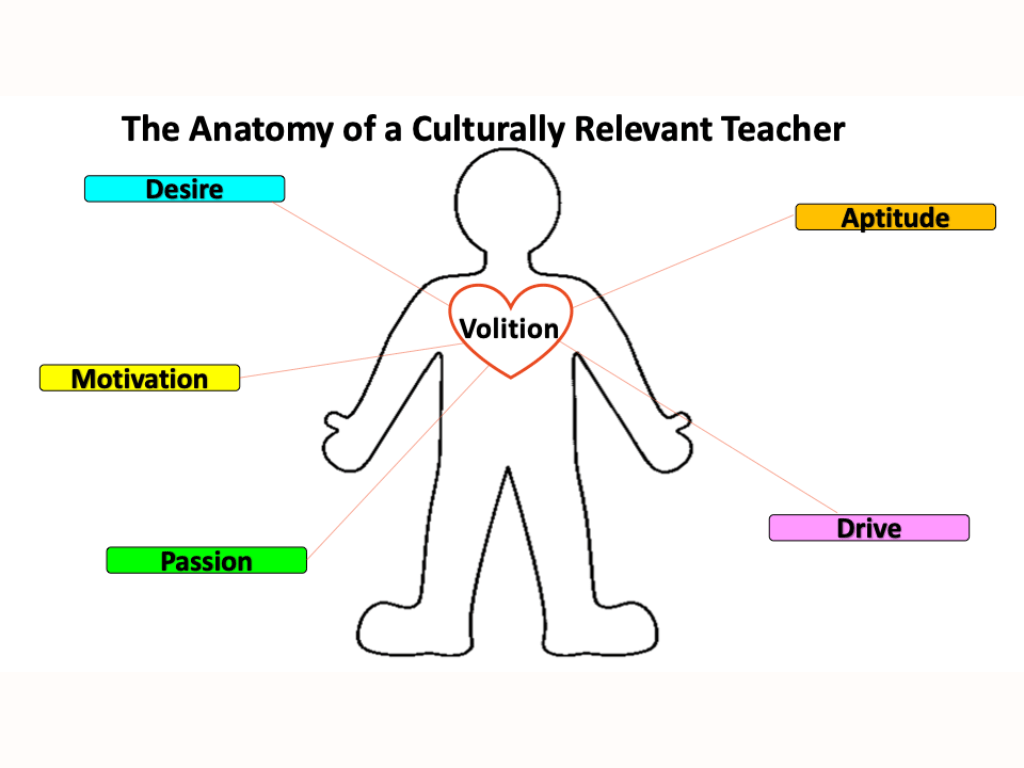
Here is the Anatomy of a Culturally Relevant Teacher. I created this analogy and this visual to demonstrate how all three components plus volition are vital for teachers to be strong, healthy, and able to improve students’ academic, social, and emotional outcomes.

I chose to use the human heart to represent volition because when we think about the heart in the context of the human body, it is one of the most essential organs. It supports the circulatory system by pumping blood through your veins and arteries. This is how all areas of your body get the oxygen and nutrients they need to survive and thrive!

Knowing what the heart does for the human body, let’s consider what volition does for the culturally relevant teacher. Similar to how the human heart stores oxygen and nutrients for the human body, a culturally relevant teacher’s heart, what I call volition, stores a teacher’s will, desire, passion, motivation, aptitude, and drive for teaching. It supports a teacher’s ability to survive, thrive, and improve student outcomes.
Teachers with high work volition:
- Deliberately choose to teach because they love children and want to transform their lives. Being a teacher is their first and personal preference and a decision they made with their heart. Their love and value for teaching and learning come from within and are not determined by the environmental context.
- Believe that there are many opportunities to improve student outcomes, especially for students that have been historically underserved. They recognize the challenges and educational inequities that exist, and they make teaching and learning-related decisions with the belief that they can overcome those challenges.
- Demonstrate emotional intelligence and can manage and change their emotions, thoughts, and behaviors to deal with uncertainty in the rapidly changing school environment that is difficult to predict.
- Exude altruism. They are selfless and are deeply concerned for the welfare of their students.
- Possess a clear sense of agency, ownership, and personal responsibility. They believe that they can design meaningful learning experiences for their students through their intentions and actions.
Considering those descriptions of teachers with high work volition, what does it mean for a teacher whose first preference is not teaching. Does that mean they don’t have volition? Does that mean they are not culturally relevant? Maybe they don’t love children but care about them. They may not feel personally responsible for student outcomes. Perhaps they struggle emotionally. Does that mean they don’t have volition or are not culturally relevant? Does a teacher have to have all or some of the traits of volition to be considered culturally relevant?
Well, there are levels to it. We know that healthy and robust hearts give our bodies what they need to thrive and survive. The stronger our hearts, the better our brains and bodies function.
Our bodies and brains don’t function optimally if our hearts are not so strong. And we know what happens when our hearts completely stop. Blood stops flowing, and our organs do not get the oxygen and nutrients needed to survive, which usually results in death.
The same idea applies to the hearts of culturally relevant teachers. A teacher’s heart or volition supports their critical consciousness, cultural competence, and ability to advance student learning. A weak heart, aka low volition, can lead to death in the classroom. Conversely, weak hearts can be strengthened, and treatment looks different for every teacher based on individual needs. The stronger the teacher’s heart, the higher the volition and high volition supports improved student outcomes, which is the purpose of culturally relevant pedagogy.
I would love to hear your thoughts about volition. Remember, it’s not part of Dr. Gloria Ladson’s Billings framework. It’s a word I learned while reading The Pedagogy of the Oppressed by Paulo Freire. It means the power to make your own decisions or choices, and choosing to be an educator and deliberately deciding to take actions that improve the lives of marginalized children is what the theory of culturally relevant pedagogy is ultimately all about.
Let me know your thoughts about volition as it relates to culturally relevant pedagogy. I look forward to reading your reflections in the comments.
With love and volition,
Tamera
Watch this video to reinforce what you just learned.
 Tamera Malone
Leave a comment