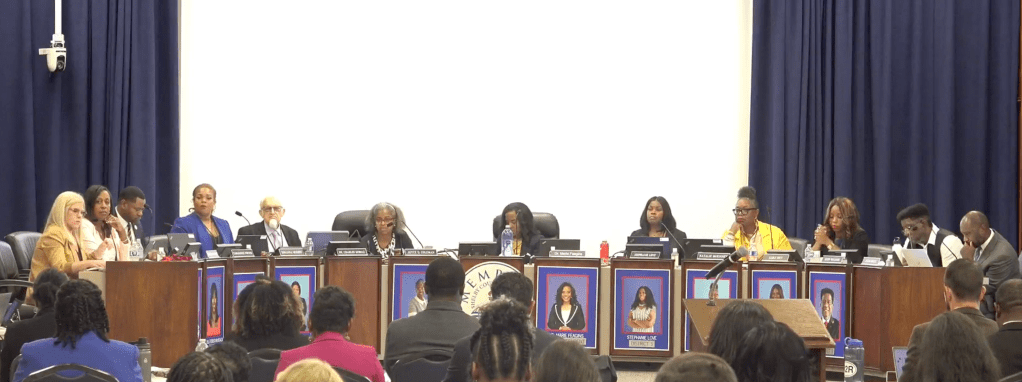
If you’re passionate about the future of education in Memphis Shelby County Schools (MSCS), staying informed about the decisions being made at the district level is essential. To make it easier for you to follow along, I’ve not only compiled detailed notes from the first two MSCS board meetings with the newly elected board members, but I’ve also organized them into key topics for access based on interest and understanding. These discussions cover everything from policy changes and new initiatives to critical issues like unhoused students, pre-K funding, school safety, and the district’s legislative agenda.
In this post, you’ll find a breakdown of the most important points raised during the Memphis Shelby County Schools Board meetings held September 10 and September 17. This post includes key insights from board members and district leaders on a variety of pressing topics. Whether you’re an educator, parent, or community advocate, this structure will allow you to easily navigate to the areas that matter most to you.
Before you dive in! If you want to stay updated on the latest developments within Memphis-Shelby County Schools and beyond, be sure to subscribe to my newsletter for in-depth insights, resources, and updates delivered straight to your inbox. And don’t forget to hop over and subscribe to my YouTube channel, where I break down key education topics, share actionable tips, and reflect on the impact of policies and decisions in our schools.
- Dual Enrollment
- The district met with university presidents to discuss strengthening partnerships and increasing student opportunities in dual enrollment programs. Specific outcomes from the meetings were not shared.
- Unhoused/Displaced Students
- Commissioner Love expressed concern that the district’s numbers regarding displaced and unhoused students do not align with the city’s figures. In response, the district stated that they are working to strengthen the process for identifying these students. Love also raised an issue about principals potentially denying unhoused students enrollment, which prompted further discussion on improving communication and processes.
- Commissioner Porter suggested streamlining information between the district, city, and county, advocating for a more holistic approach to addressing the issue.
- Commissioner Coleman inquired about the possibility of a 24 hour homeless hotline, to which the district responded that while they don’t currently have one, the idea could be explored. The district call center currently handles inquiries during regular business hours.
- Commissioner McKinney requested trend data to better collaborate with other systems (city, county, and state government) to address the root causes of homelessness, while Murphy asked about partnerships to minimize homelessness. The district confirmed partnerships with organizations like MIFA, Room in the Inn, HUD, Community Alliance for Homelessness, and the Salvation Army. Once a family is identified as homeless, they undergo a needs assessment within 48 hours, followed by referrals to the appropriate agencies.
- School Uniform Policy
- Commissioner Murphy suggested that the school uniform policy should be universal across all schools to prevent students from avoiding school due to bullying related to clothing choices. The district noted that most schools without a uniform policy are legacy Shelby County schools. Schools like White Station and Central serve a specific demographic that prefers no uniforms. Commissioner Love then asked whether the lack of a uniform policy impacts student attendance.
- Communications Update
- The district acknowledged the need to improve how they receive and organize information in a timely manner, including media relations, incident reports, and district events. They also highlighted the importance of crisis management training for administration, teachers, school resource officers (SROs), counselors, and staff to ensure everyone knows how to handle a crisis effectively.
- Commissioner Huett-Garcia inquired about the district’s regular communication with the media, asking whether they maintain relationships with journalists and how frequently they update them. The district explained that they have a master list of media contacts and respond to inquiries via email, taking time to ensure accuracy before releasing information. However, they do not currently hold regular press briefings.
- Commissioner Coleman suggested the board could assist with communications, proposing PSAs or radio appearances to support outreach. She noted that the new communications director, Jermaine Johnson, had not met with the board yet.
- Director Johnson, who had been in the role for one month, explained that while the board is a priority, they are intimidating, and he wanted to become familiar with them before reaching out. He promised that communication would improve.
- Commissioner Love also expressed concern that Johnson had yet to speak to the board and praised John Best, the district’s communications manager, as a great asset to the community.
- Legislative Agenda
- The administration asked the board to begin thinking about legislative agenda ideas for the January session, aiming for approval by November.
- Commissioner Murphy raised concerns about the law requiring kindergartners to be expelled for zero-tolerance offenses and suggested advocating for alternatives to expulsion.
- Commissioner Love emphasized collaborating with municipalities or other governing bodies on shared legislative priorities and voiced concerns about truancy, expressing opposition to punitive measures like locking up parents or withholding benefits.
- Commissioner McKinney expanded on this by asking how the district can work with other entities to address truancy’s root causes and suggested a more compassionate, non-detrimental approach to dealing with families.
- Youth Court
- The district partners with the Juvenile Court System to provide Youth Court, a program open to all seniors. The district is strengthening communication efforts to ensure that students and families are well-informed about the program. However, no metrics are currently in place to measure the program’s impact. The district has acknowledged the need to develop ways to assess its effectiveness moving forward.
- Pre-K
- The district has 4,525 Pre-K students, with programs under Head Start and First 8 Memphis.
- The district risks losing 30 million dollars in federal funding for Head Start. Once it’s released, the district will prepare to submit the Head Start continuation application and will have 60 days to complete it. Late reporting on incidents and citations related to student discipline has been challenging.
- Commissioner McKinney asked, “What are we putting in the application to ensure we are addressing the deficiencies?” In addressing concerns about deficiencies in the Head Start program, the district’s plan includes providing more classroom support for teachers, such as de-escalation training, a coaching corner, and coaching plans, as well as giving teachers necessary breaks.
- Commissioner McKinney emphasized that the board needs to actively support these initiatives and that the application must clearly show what the district will do differently.
- Commissioner Love followed up by asking, “What happens if we do not get this grant?” Superintendent Feagins responded that the district had already reviewed other budget options to cover the potential loss.
- Board Member Love has suggested that new board members receive a coaching course on Pre-K and expressed willingness to assist in addressing these deficiencies. The district is also facing situations where families just one dollar over the income threshold are being denied access to Pre-K programs, highlighting the need for a more flexible approach.
- Commissioner Love asked, “Do we have the money to expand the district-funded classrooms next year?” The district responded by explaining that while they could expand the district-funded classrooms, a challenge arises in deciding which families would be chosen to participate, given there’s no income requirement. The district currently funds 27 Pre-K classrooms but doesn’t have the funding for universal Pre-k. Additional classrooms could be funded if they strategically cut or move funds. Commissioner McKissack emphasized that the city, county, and state need to step up to help fund these efforts.
- Commissioner McKinney inquired about the district’s strategic efforts to increase enrollment, acknowledging the current “Hey Neighbor” initiative but asking what other capacities the district has to continue such efforts. The district is focusing on community engagement strategies like “Hey Neighbor” recognizing that it is not sustainable but a reasonable effort. The district is also evaluating other methods to ensure consistent and effective enrollment growth.
- Digital Platforms (School Links and Prodigy Math)
- Prodigy Mathematics
- The Prodigy Mathematics is a game-focused incentive that is not mandatory and was selected based on student feedback. While Prodigy is not a replacement or supplement for the district’s current resources, like I-Ready, it was introduced as an engaging tool for students.
- Board Member Murphy questioned what professional development (PD) would be provided. In response, the district explained that the vendor will offer virtual PD and asynchronous resources.
- Board Member Porter asked if Prodigy aligns with the current curriculum and standards, and the district clarified that it does not, as it is more of a game-based incentive than a standards-aligned resource.
- Commissioner Murphy expressed concerns that the district should focus on passing TCAP and aligning incentives with the curriculum.
- Commissioner McKinney questioned how the district plans to measure the tool’s effectiveness, particularly how it will contribute to a 5% increase in math achievement. The district responded that it disaggregates key performance indicators (KPIs) for each tool to measure impact.
- Commissioner Love added that teachers must have autonomy in the classroom and asked if teachers were on board with using Prodigy. The district reiterated that the decision was based on student feedback.
- School Links
- School Links is a new online college and career readiness platform chosen because it is more cost-effective than the previous platform, Naviance, which had technical issues and did not provide a strong return on investment (ROI). Board Member Love requested a cost and service comparison between School Links and Naviance and asked if Superintendent Feagins instructed the team to accept this contract, also inquiring about the specific advantages of each platform.
- Commissioner McKinney emphasized the need for key performance indicators (KPIs) to ensure that the district receives an appropriate return on investment and to collect qualitative and quantitative data for analysis.
- Commissioner Coleman added that the board should receive information on ROI for new contracts, including how many students will be impacted and how seniors will be informed of the platform’s importance.
- The district explained that they are working to understand which contracts effectively move the needle and that progress reports will be provided quarterly for all contracts.
- Commissioner Coleman also questioned why onboarding for school counselors and graduation coaches wouldn’t occur until October. The district clarified that they initially did not involve counselors and leaders in the decision-making process, so they went back to collect their feedback and ensure the platform was the right fit.
- Board members Love and Murphy expressed concerns about whether the platform was being rushed and whether implementation could be postponed to next year to ensure it is done correctly.
- Commissioner McKinney raised a question about compliance since Naviance was discontinued, but the district representative assured that the district is not out of compliance and has an entire year during which they have been using Slate until School Links is fully implemented. All high schools currently have counselors, and some also have two graduation coaches to support students.
- Commissioner Love emphasized the importance of including counselors in the process from start to finish, especially in the training phase, to prevent last-minute preparation. In response, Dr. Feagins assured that counselors selected the platform, and once the contract is approved, work will begin promptly. She also mentioned that this platform will provide a tangible way to track and monitor progress.
- College, Career and Technical Education
- Dr. Richmond oversees the work on CCTE, and it is currently in process. The district is actively engaging with schools, and the budget focus is on middle school programs. The CCTE department is highly complex, and leadership changes occurred on and after August 2. Currently, there is an interim manager, and the position is open for a permanent hire. The comprehensive CCTE plan will be presented to the board in October.
- Gun Referendum and MATA
- Commissioner Love introduced a resolution supporting the Memphis City Council’s gun referendum and disapproving of any termination of Memphis Transit Authority bus routes. All board members unanimously agreed with the resolution.
- More for Memphis
- Commissioner McKinney submitted a resolution for the Board to convene an Ad Hoc Committee to work with the Superintendent, Superintendent designees, and internal and external stakeholders. The purpose is to determine where the district’s adopted strategic plan may align with the “More For Memphis” plan and other community strategic partnership initiatives.
- Commissioner McKissack expressed that the board needs a say in who is appointed to the Ad Hoc Committee. Commissioner Love agreed with the resolution but emphasized that the board must provide input on this matter.
- Commissioner McKinney argued that the district needs a strategic plan first before alignment with the “More for Memphis” plan can be considered. Commissioner McKissack noted they hadn’t voted for a committee chair, but Commissioner McKinney clarified that Coleman is the chair by default and reassured that they’re not overstepping the previous board’s authority.
- Commissioner Murphy agreed to send it back to the committee for further discussion, Commissioner McKinney preferred keeping it on the agenda, and Commissioner Coleman concluded by suggesting a vote at the next business meeting to decide on whether to proceed or send it back to the committee.
- Visitor Code of Conduct
- Commissioner Otey raised concerns about families potentially targeted by the Visitor Code of Conduct and asked if the wording could be reviewed. Dr. Feagins explained that much of the language in the code comes from state regulations but welcomed specific examples for review. Commissioner Otey mentioned she didn’t have examples on hand but would provide them via email.
- Staff Benefits and Job Restructuring (Health Care)
- Cigna is the district’s health care provider. The district wants to extend the contract one more year but looking to release a request for proposal (RFP) for future healthcare providers with feedback from staff.
- Commissioner Huett-Garcia asked about the primary drivers of the district’s health insurance cost, to which the district responded that the key factors are diabetes, high blood pressure, asthma, and sickle cell. The district covers 70% of the cost, and employees cover 30%.
- Commissioner Love asked if the superintendent had met with Cigna, and Dr. Feagins confirmed she had not.
- Commissioner McKinney inquired if the contract would change employee contributions. Dr. Feagins clarified that it would not, as this is just a one-year extension to avoid a coverage gap while exploring options for opening the bidding process.
- Commissioner Otey raised a concern from a teacher asking whether, since pay had decreased, benefits could be increased to provide additional support. Dr. Feagins responded by saying any concerns should be forwarded to the team, as they have been discussing compensation and benefit options for employees affected by job restructuring and changes can be made during open enrollment.
- Commissioner Otey emphasized the need to explore ways to support employees whose pay was reduced but did not have the opportunity to decrease their benefits. Commissioner Love agreed with Otey, asking what could be done to offset benefit costs until open enrollment (November 1), as employees based their benefit choices on their original salaries. Dr. Feagins explained that changes to benefits could only be made under certain circumstances and questioned what the board expected regarding this potential support, including the financial feasibility of offsetting the cost.
- Commissioner McKinney supported Commissioner Otey and Love, asking if creative options could be explored to assist those most in need. At the same time, Commissioner Huett-Garcia, who expressed empathy, cautioned that any intervention should consider the broader scope of employees’ financial challenges beyond health care, mentioning that employees can choose other employment if necessary.
- Commissioner McKissack raised concerns about the timeline, while Dr. Feagins reiterated that adding new support could take away from other critical budget commitments. Commissioner McKissack noted that some support had already been provided through extended pay and severance.
- Commissioner Huett-Garcia expressed that further options were unnecessary, while Commissioner Coleman suggested tabling the discussion. Commissioner McKinney insisted that discussing this publicly would show employees that efforts were being made.
- Access to Technology at Home
- Commissioner McKinney raised the issue of ensuring that younger students have access to laptops at home and emphasized the importance of teaching them how to use the devices properly from an asset-based perspective.
- Dr. Feagins acknowledged that, at times, laptops do not make it back to school or come back with damages. She explained that this situation is not necessarily due to irresponsibility but rather reflects the nuanced experiences of students and families. Managing district assets, including laptops, is essential, and the district is reviewing the process of allowing students to take laptops home.
- Dr. Feagins also mentioned that students have voiced concerns about not being able to take laptops home, especially those participating in dual enrollment programs. However, balancing this with the risk of not having devices returned remains a challenge, particularly when the district does not want to charge families for lost equipment.
- Commissioner McKinney followed up by asking how many laptops are being lost, urging the need for data-informed decisions and transparency with the public about the reasoning behind the district’s policies. Dr. Feagins acknowledged the concern and promised to provide data on the number of lost laptops.
- Richard Borora has been appointed to oversee the IT department, ensuring the district’s technology infrastructure, systems, and processes are effectively managed and supported.
15. Exceptional Education
- Dr. Tiffany Luckett, the Executive Director of Exceptional Education, gave an enthusiastic presentation about her department’s work. Board Member Love commented, “You love your job,” highlighting Dr. Luckett’s passion.
- Board Member Porter asked about the department’s immediate needs. The district identified vacancies and ensuring teachers have the necessary support and resources to provide individualized services to students as its top priorities.
- Board Member McKinney praised the report and inquired if complaints go directly to the state or a local process exists. The district clarified that while complaints can go straight to the state, they also have a local process in place with a 10-day response window for complaints.
- The district also explained that deployed advisors, still receiving their advisor salaries and additional incentive pay, have been placed in classrooms to teach. Each advisor was met with individually to explain their options, and all of them agreed to the change. Their work schedule is now 8 a.m. to 5 p.m.
- The board expressed that they were impressed with the new executive director and her leadership.
The recent board meetings have highlighted several key areas of focus for Memphis Shelby County Schools, from enhancing community relations and addressing student needs to improving district policies and communication strategies. These discussions reflect the district’s ongoing commitment to creating an equitable and effective learning environment for all students and staff. By staying informed and engaged, we can collectively support the district’s mission and contribute to meaningful progress.
If you’re passionate about education and want to stay up-to-date with the latest developments in our district, be sure to subscribe to my newsletter and YouTube channel. Let me know your thoughts in the comments and check out my latest Youtube video below about the Superintendent’s Evaluation!
With love and civic engagement,
Tamera
 Tamera Malone
Leave a comment