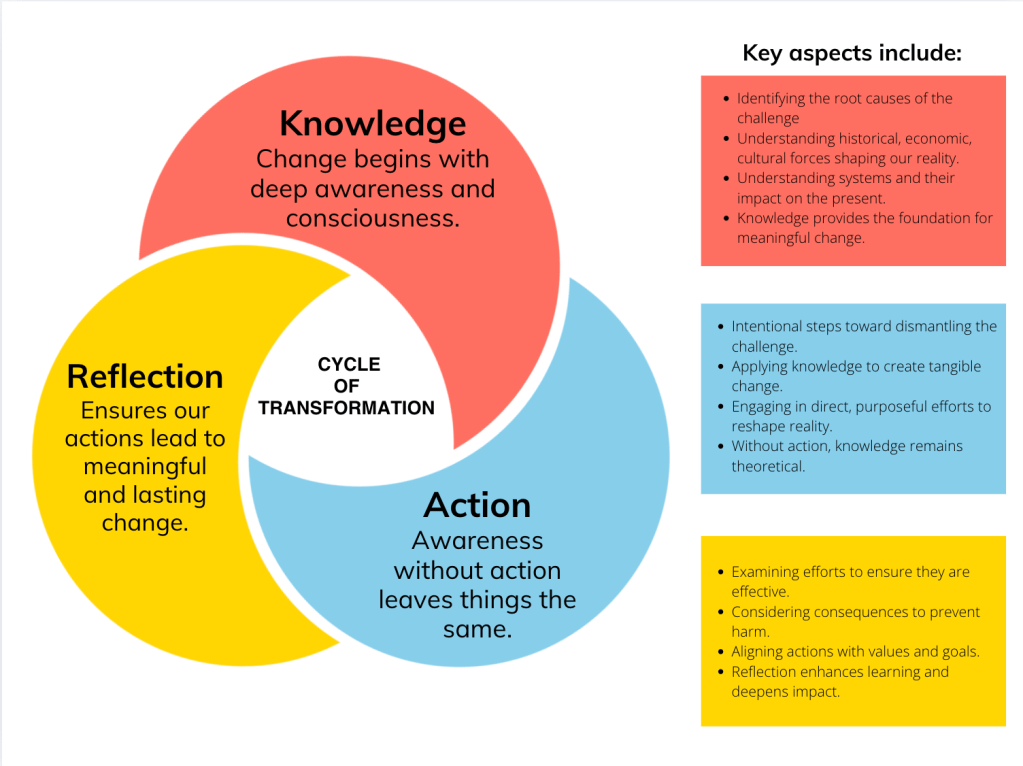
Liberation is not a one-time event but an ongoing practice that demands effort, understanding, and the courage to act in transformative ways. It goes beyond merely desiring change; true liberation occurs when individuals take purposeful action and reflect on their reality to reshape it.
As Paulo Freire teaches, transformation is impossible without a deep understanding of the world and its complexities. Every revolution, whether in education, social justice, or community building, is inherently educational. Meaningful change requires engaging in a continuous cycle of Knowledge, Action, and Reflection. These three interconnected elements ensure that transformation is both intentional and sustainable.
Knowledge: Understanding the World to Change It
Knowledge goes beyond facts and information; it is a deep awareness, consciousness, and understanding of the world. To change society, we must first comprehend the forces shaping it. Knowledge involves awareness of reality and an understanding of how others perceive and experience the world.
It requires identifying the root causes of social conditions, such as oppression and inequality, and recognizing how historical, economic, cultural, and political forces influence the present. It allows us to analyze current events, not as isolated occurrences but as part of larger systemic patterns. Knowledge is the foundation of transformation, providing the clarity needed for meaningful change. Without it, action becomes directionless, and any progress is fleeting.
Action: The Process of Transformation
Knowledge alone is insufficient; awareness without action leaves the status quo intact. To create meaningful change, deliberate steps must be taken to reshape reality. Action is the process of transforming the world, and it must be intentional, purposeful, and focused on the structures that need to change. Transformation is impossible without action, as it allows us to apply what we know to dismantle oppression and work toward a more just society. Without action, knowledge remains theoretical, but through action, ideas move from mere awareness to tangible, real-world change.
Reflection: Ensuring Thoughtful and Effective Change
Reflection strengthens both knowledge and action by providing a critical lens through which we examine our efforts to ensure they are intentional and effective. It involves actively considering the consequences of our actions, helping to prevent harmful or misguided choices while reinforcing purposeful change. Reflection is not limited to a single moment; it happens before, during, and after action, keeping our work aligned with our goals.
By engaging in reflection, we gain deeper knowledge, which enhances the quality of our actions. In this way, critical reflection becomes a form of action, pushing us to engage with the world in more meaningful and impactful ways. Without reflection, activism often becomes reactionary and short-sighted, resulting in efforts that fail to create lasting change. Reflection ensures that our actions are both passionate and strategic, paving the way for transformative and sustainable outcomes.
The Interdependence of Knowledge, Action, and Reflection
Each of these elements is essential. None can exist alone. Transformation requires all three. We must know the world deeply, act to change it, and reflect to refine our efforts. This is the only way to pursue liberation and full humanity. Through this continuous cycle, we do more than imagine a better world. We take steps to build one.

With knowledge, action, & reflection,
Tamera
Check out this video to learn more.
 Tamera Malone
Leave a comment