Imagine a classroom where learning isn’t just about formulas and facts but empowers students to thrive in their experiences, identities, and communities. A classroom that elevates student success by building bridges between academic rigor and cultural affirmation. This is a culturally relevant teacher’s classroom.
Dr. Gloria Ladson-Billings, an educational luminary, developed the theory of culturally relevant pedagogy after studying eight successful teachers of African American students. These teachers, the “DreamKeepers,” as she called them, were thoughtful, inspiring, demanding, and critical. They were connected to their students, their students’ families, and their students’ communities. Their classrooms centered on advancing student learning while honoring and leveraging students’ strengths and cultural backgrounds.
But what exactly is culturally relevant pedagogy? It is a theoretical framework that outlines the methods and practices of successful teachers of black students. These teachers are critically conscious, culturally competent, and can advance student learning. Note that while this study was conducted with eight successful teachers of African American students, the theory of culturally relevant pedagogy can apply to successful teachers of any group whose academic, social, and emotional needs have historically been unmet in schools.
Let’s use the human body as an analogy to understand this transformative approach. Just like the human body, the culturally relevant teacher is made up of internal and external principles that keep teachers healthy and improve student outcomes.
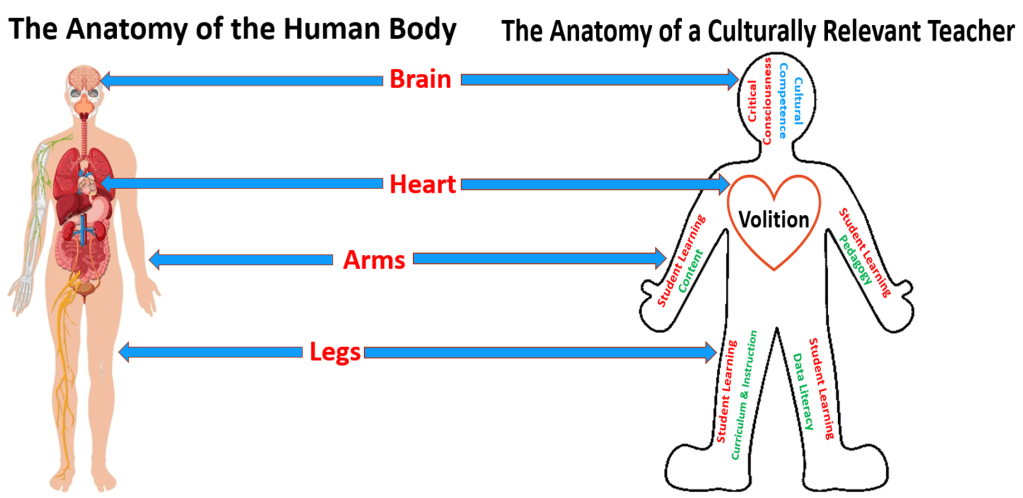
The Brain: The human brain is in charge of everything your body does. It is divided into two hemispheres that always remain in contact and communicate with each other. The brain is like an extremely powerful computer, like a control center that stores memories and controls our thoughts and bodies. In the context of a culturally relevant teacher, the brain represents critical consciousness and cultural competence, which is the teacher’s control center for advancing student learning.
The left brain, critical consciousness controls the teacher’s ability to critique and challenge the current social order, specifically systemic oppression. Critical consciousness also controls the teacher’s ability to get students to take what they learn in schools and use it to transform their communities and create new possibilities.
The right brain, cultural competence, controls the teacher’s ability to appreciate and celebrate her own culture while learning about at least one other. Cultural competence also controls the teacher’s ability to use students’ culture as a bridge to student learning.
The Arms & Legs: Student Learning: In the context of the human body, our arms have many muscles that work together to allow us to perform all sorts of motions and tasks. The legs provide support and a range of movements. In the context of a culturally relevant teacher, the arms and legs represent student learning.
Strong arms and strong legs support intellectual growth and academic excellence. The left arm represents content. The left leg represents curriculum and instruction. The right arm represents pedagogy. The right leg represents data literacy. These domains – content, pedagogy, curriculum and instruction, and data literacy- significantly impact student learning.
*The Heart: Volition: The human heart is one of the most essential organs in the body. It supports the circulatory system by pumping blood through your veins and arteries. This is how all areas of your body get the oxygen and nutrients they need to survive and thrive! In the context of a culturally relevant teacher, the heart represents volition, which holds a teacher’s desire, passion, motivation, aptitude, and drive to improve student outcomes. The culturally relevant teacher’s heart, aka volition, supports and develops all areas of the teacher’s body.
Just like the human body has internal and external organs that keep it healthy and effective, culturally relevant teachers have specific knowledge, skills, and dispositions that keep them healthy and effective. When teachers are culturally relevant, they engage in teaching that focuses on advancing student learning, developing cultural competence, and fostering critical consciousness. They are constantly evolving to meet the needs of their students. They are transformative. They are revolutionary. They are Dream Keepers, and every child in every classroom across the United States deserves access to Dream Keepers, especially children from marginalized communities.
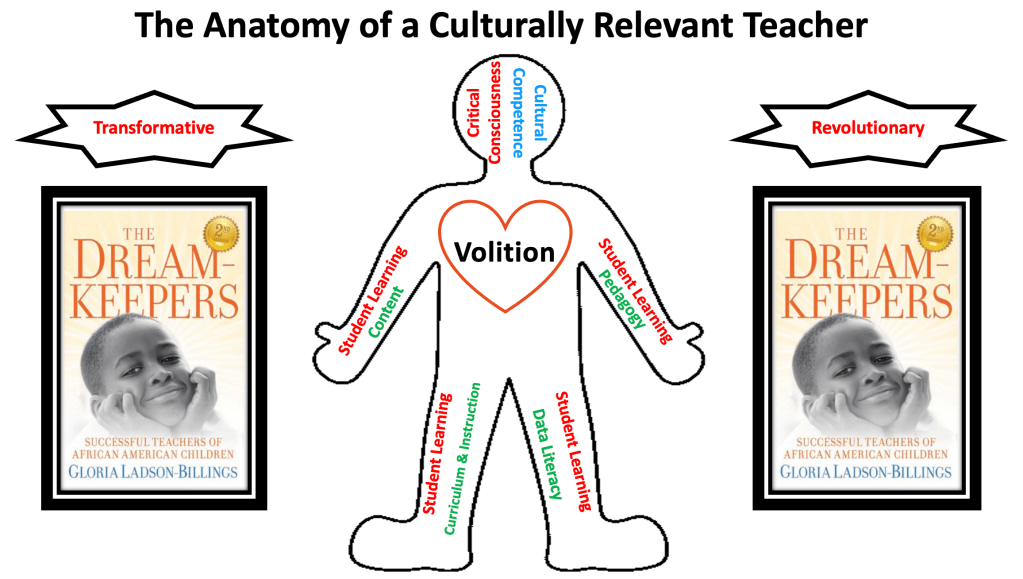
But culturally relevant pedagogy isn’t just about individual classrooms but about systemic change. It’s about liberation. We must ask ourselves: how do we cultivate DreamKeepers, those culturally relevant teachers who can improve student outcomes? How do we attract, train, and support them in their work?
Let me know your thoughts in the comments.
Check out the youtube video below for more on the topic!
*Dr. Gloria Ladson Billings does not explicitly name volition as a component of Culturally Relevant Pedagogy. However, because I believe it is woven throughout the framework, I include it in my analysis to support my understanding.
 Tamera Malone
Leave a comment