This blog post continues our exploration of culturally relevant pedagogy (CRP), a framework for teachers developing their critical consciousness, cultural competence, and ability to advance student learning. Today, we’ll delve deeper into the concept of student learning.
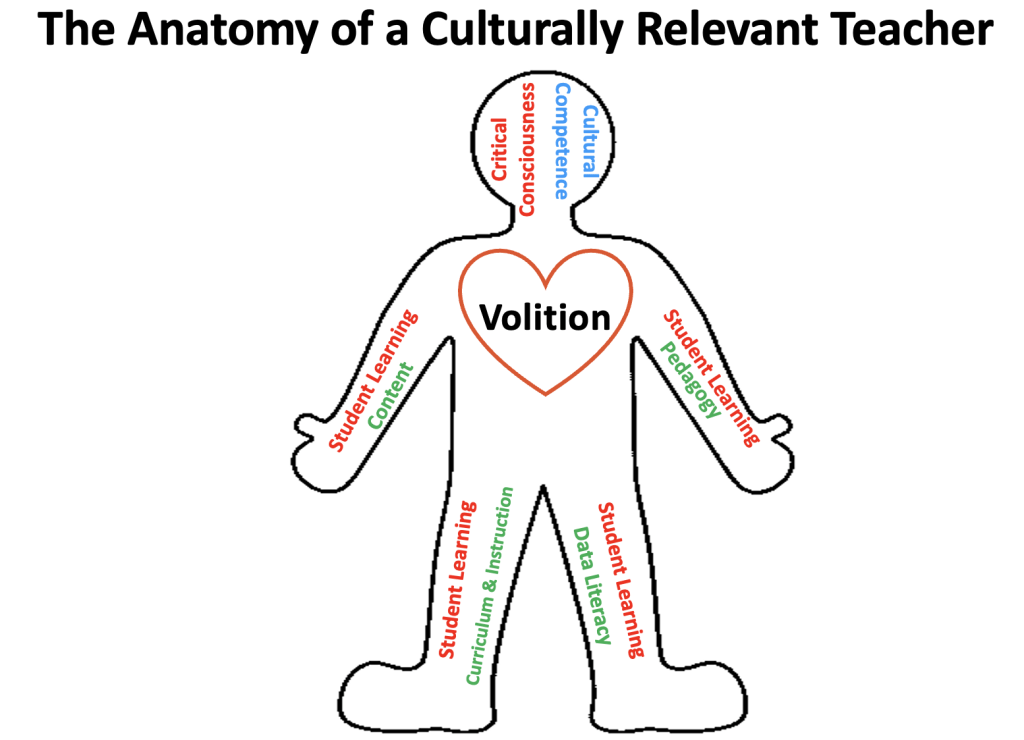
The Body Analogy: Student Learning as the Core
Imagine a culturally relevant teacher as a human body. We’ve discussed the heart (volition), left brain (critical consciousness), and right brain (cultural competence) in previous posts. Now, let’s focus on the body itself, representing student learning.
Dr. Gloria Ladson-Billings defines student learning as the intellectual growth students experience through classroom instruction. Research shows that teachers are the most important school-based factor influencing this growth and students’ social-emotional development.
The Arms and Legs of Learning
Our arms and legs enable various motions and tasks. In CRP, they represent the pillars of student learning:
- Left Arm: Content Knowledge – Teachers with solid content knowledge deeply understand their subject area, whether math, science, art, or anything else. They are experts in what they teach.
- Right Arm: Pedagogical Knowledge – Pedagogical knowledge refers to how teachers deliver content. It encompasses activities, strategies, organization, and the overall learning structure. It’s about going beyond just knowing the content itself.
- Left Leg: Curriculum and Instructional Knowledge—Teachers are often provided with curriculum materials. Curriculum knowledge involves understanding these resources and programs and how to use the tools to plan and teach their subject.
- Right Leg: Data Knowledge – Data-literate teachers can identify issues, ask questions, collect and use data, translate it into information, make decisions based on that information, and evaluate the outcomes. They know if students are learning and how to adapt instruction accordingly.
Strong Teachers, Strong Learners
Teachers with a strong grasp of content, pedagogy, curriculum, and data are well-equipped to cultivate robust student learning. Culturally relevant teachers promote intellectual growth by:
- Encouraging students to question, interpret, and analyze information in a meaningful context.
- Helping students connect prior knowledge and beliefs to new ideas.
- Designing instruction that builds upon existing knowledge.
- Promoting critical thinking, problem-solving, collaboration, inquiry, and recognizing diverse perspectives.
- Building on students’ cultural and personal strengths.
- Utilizing diverse assessment strategies to monitor progress.
- Adjusting instruction to meet individual student needs.
- Involving all students in knowledge construction.
- Encouraging students to engage with new ideas for a deeper understanding of the world.
- Building bridges between home and school, acknowledging the value of students’ families’ knowledge and experiences.
Check out this video for visuals and to deepen your understanding of student learning.
Take a moment to consider what you believe is necessary for teachers to effectively advance student learning. Share your thoughts in the comments below!
With the ability to advance student learning,
Tamera
 Tamera Malone
Leave a comment