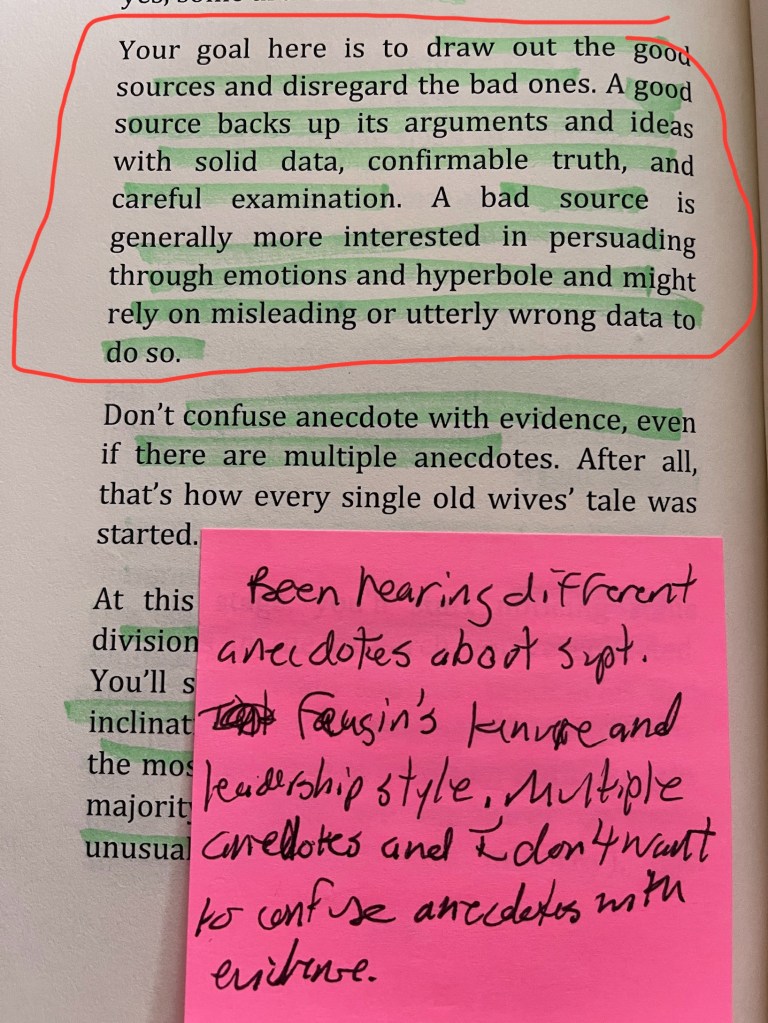
Recently, I read The Science of Self-Learning by Peter Hollins and came across a quote that helped me work through a quandary—a state of uncertainty I was in about whether to trust a series of personal stories as credible evidence. The quote reads:
“Don’t confuse anecdote with evidence, even if there are multiple anecdotes. After all, that’s how every single old wives’ tale was started.”
This insight prompted me to pause and jot down a quick thought on a sticky note, knowing I wanted to revisit it for deeper reflection later. Now, here we are! Below is the sticky note with my immediate thoughts and the highlighted passage that inspired them.
Understanding Anecdotes in Leadership Reporting
While observing and documenting Superintendent Dr. Marie N. Feagins’s work, I’ve heard numerous anecdotes about her leadership style and decision-making abilities. These personal stories range from glowing endorsements to critical perspectives, offering many opinions about her tenure so far.
Anecdotes are personal stories or individual accounts people share based on their experiences. These stories can be powerful because they add a human element to our understanding of a situation. For instance, a district administrator might share a story about how Dr. Feagins’s decision to restructure the district affected their job. This story is valid because it reflects the administrator’s personal experience and feelings. However, it’s important to remember that anecdotes are subjective and often lack the broader context needed to draw general conclusions.
Why Anecdotes Can Be Misleading
Anecdotes can be influenced by many factors, including personal bias, incomplete information, or a limited perspective. They may highlight extreme examples rather than the norm, leading to conclusions that aren’t representative of the overall situation. While anecdotes provide valuable insights, they should not be the sole basis for forming opinions or making decisions.
What is Evidence?
Defining Evidence in Leadership Evaluation
Evidence, on the other hand, is information that is supported by data, research, and verifiable facts. When we talk about evidence in the context of leadership and decision-making, we’re referring to information that can be objectively measured and confirmed. For example, data on student performance before and after the implementation of a new curriculum, or teacher retention rates following a salary increase, are pieces of evidence that can be used to evaluate the effectiveness of Dr. Feagins’s initiatives.
Evidence allows us to move beyond personal opinions to understand the real impact of decisions and actions. Unlike anecdotes, which can be skewed by personal bias, evidence provides a more reliable foundation for drawing conclusions. It’s through evidence that we can fact-check our assumptions and ensure that our reflections are grounded in reality.
Why the Distinction Between Anecdote and Evidence Matters
The distinction between anecdote and evidence is crucial because it influences how we interpret information and form our opinions. If we rely too heavily on anecdotes, we risk developing a skewed or inaccurate view of reality. For example, hearing a few negative stories about Dr. Feagins’s leadership might lead one to believe that her tenure has been unsuccessful, even if broader evidence suggests otherwise.
Evidence, on the other hand, provides a balanced and accurate picture. By focusing on data and verifiable facts, we can better understand the true impact of leadership decisions. This doesn’t mean that anecdotes should be dismissed outright—they can provide valuable context and humanize the data—but they should be considered alongside evidence, not in place of it.
How to Balance Anecdotes and Evidence in Reporting on Leadership
Conducting Surveys and Focus Groups for Verification
If there are enough negative stories about Dr. Feagins’s leadership to raise concern, it would be wise to support or refute these claims through systematic investigation. Conducting a survey or a series of focus groups could help gather a broader range of perspectives, identify trends, and verify the validity of these personal stories with concrete evidence. This type of data collection enables a more objective understanding of the general sentiment within the school district while validating or debunking anecdotal claims.
My Approach to Sharing Knowledge Responsibly
As I continue to share my thoughts and reflections on Dr. Feagins’s work, my goal is to be as accurate and responsible as possible. I will continue to collect and analyze data, cross-reference information, and rely on solid evidence to support my arguments and ideas. At the same time, I’ll also share anecdotes and personal stories that add depth and context to the discussion, but I’ll be clear about the difference between these stories and the evidence I use to back up my conclusions.
In the end, I believe that it’s possible to present a fair and balanced view by blending evidence with personal reflection. By acknowledging the limitations of anecdotes and the importance of evidence, I hope to provide you with insights that are both thoughtful and reliable.
Conclusion: Seeking a Balanced Perspective
I’m not a journalist by trade, but I strive to present information accurately and responsibly. I never want to be misleading or utterly wrong—at least not intentionally. My goal is to be a thought leader, a reliable source who can back up arguments and ideas with solid data, confirmable truths, and careful, fastidious observations.
In our pursuit of understanding leadership, particularly in the educational landscape, it’s essential to discern between anecdotal accounts and verifiable evidence. Anecdotes provide a personal touch and context, but evidence offers the reliability needed for informed decision-making.
Thank you for riding with me on this journey of learning, action, and reflection. Let’s continue to seek the truth together, and remember the importance of distinguishing between anecdote and evidence in our pursuit of understanding.
Reflection Questions: Anecdotes vs. Evidence in Leadership
- What’s the difference between an anecdote and evidence in leadership evaluation?
- Why is it risky to rely solely on anecdotes when evaluating leadership?
- How can evidence improve our understanding of leadership performance?
Have a Story to Share?
I’d love to hear from you! What are your thoughts on anecdotes versus evidence in leadership evaluation? Share your experiences and reflections in the comments below.
Subscribe for More Insights
If you found this discussion helpful, subscribe to my newsletter and my Youtube channel for more insights on leadership, learning, and personal reflection.
With love, anecdotes, and evidence,
Tamera


 Tamera Malone
Leave a reply to Tamera Malone Cancel reply